
Prosecutor Serge Brammertz Addresses the United Nations Security Council
Today, Prosecutor Serge Brammertz of the International Residual Mechanism for Criminal Tribunals (Mechanism) addressed the United Nations Security Council.
The Prosecutor focused his remarks on the future of the Mechanism and its residual functions. He highlighted the three issues he considers most essential: first, the enforcement of sentences of those convicted by the Tribunals and Mechanism; second, supporting national efforts to achieve more justice for more victims of crimes committed in Rwanda and the former Yugoslavia; and third, promoting truth, reconciliation and education through public access to the Mechanism’s archives.
Prosecutor Brammertz began by recalling what has been achieved in the last three decades. He stated, “Through the ad hoc Tribunals and Mechanism, the Security Council and the United Nations achieved an unequaled record of accountability and justice. 254 persons indicted, and 154 convicted. No fugitives at large.” This record, the Prosecutor noted, is “a testament to the United Nations’ commitment to justice and accountability.”
Regarding enforcement of sentences, the Prosecutor emphasized the core principle of criminal justice. As he noted, “The Tribunals and the Mechanism were mandated to prosecute individuals and hold them personally responsible for their crimes. Their guilt is theirs alone. Their punishment is for what they did, the crimes they committed. Not collective responsibility, but individual criminal responsibility.”
Focusing on the present work of the Office of the Prosecutor (OTP), Prosecutor Brammertz highlighted that “one of the most important achievements of the Completion Strategies has been that Member States fully assumed responsibility to continue the accountability process.” He reminded the Council that more work remains to be done, as Rwandan authorities are still seeking more than 1,000 génocidaires, while in the countries of the former Yugoslavia, more than 2,000 suspects still need to be investigated. He reported, “Member States consistently underscored the practical indispensability of my Office in supporting their work. Achieving justice in their courts depends on the evidence and expertise my Office provides.”
Finally, Prosecutor Brammertz reflected on the value of the Mechanism’s archives. He explained, “It is critical that the stories of the victims and survivors live on. It is by remembering them that we honor them.” He further emphasized, “This truth is needed now more than ever. Unfortunately, the denial of the crimes and glorification of war criminals persists. Reconciliation depends on full respect for the suffering of all victims from all groups.” He also noted that the lessons of Rwanda and the former Yugoslavia remain vitally relevant, as “[e]ducation about what occurred helps identify warning signs for the future. And it contributes to preventing future atrocities.”
In sum, Prosecutor Brammertz offered three important recommendations based on his experience as Prosecutor of the ICTY and now the Mechanism. The Mechanism should continue to bear responsibility for enforcing the sentences of those convicted by the Tribunals and the Mechanism. The OTP’s mandate to assist national jurisdictions prosecuting crimes committed in Rwanda and the former Yugoslavia should be transferred to the United Nations Secretariat, together with its evidence collection and some staff. And the Mechanism’s archives should be transferred to the United Nations for long-term management and access by the public.
The Prosecutor concluded: “The Council has provided its steadfast support to the Tribunals and Mechanism since their establishment. Thanks to that support, so many victims in Rwanda and the former Yugoslavia have received the justice they deserve.”
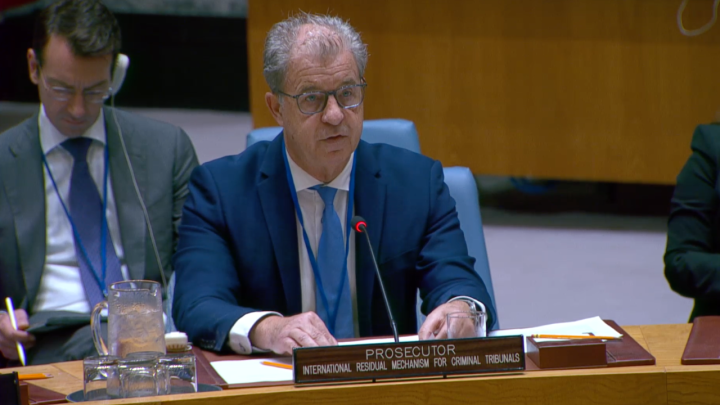
Today, Prosecutor Serge Brammertz of the International Residual Mechanism for Criminal Tribunals (Mechanism) addressed the United Nations Security Council.
The Prosecutor focused his remarks on the future of the Mechanism and its residual functions. He highlighted the three issues he considers most essential: first, the enforcement of sentences of those convicted by the Tribunals and Mechanism; second, supporting national efforts to achieve more justice for more victims of crimes committed in Rwanda and the former Yugoslavia; and third, promoting truth, reconciliation and education through public access to the Mechanism’s archives.
Prosecutor Brammertz began by recalling what has been achieved in the last three decades. He stated, “Through the ad hoc Tribunals and Mechanism, the Security Council and the United Nations achieved an unequaled record of accountability and justice. 254 persons indicted, and 154 convicted. No fugitives at large.” This record, the Prosecutor noted, is “a testament to the United Nations’ commitment to justice and accountability.”
Regarding enforcement of sentences, the Prosecutor emphasized the core principle of criminal justice. As he noted, “The Tribunals and the Mechanism were mandated to prosecute individuals and hold them personally responsible for their crimes. Their guilt is theirs alone. Their punishment is for what they did, the crimes they committed. Not collective responsibility, but individual criminal responsibility.”
Focusing on the present work of the Office of the Prosecutor (OTP), Prosecutor Brammertz highlighted that “one of the most important achievements of the Completion Strategies has been that Member States fully assumed responsibility to continue the accountability process.” He reminded the Council that more work remains to be done, as Rwandan authorities are still seeking more than 1,000 génocidaires, while in the countries of the former Yugoslavia, more than 2,000 suspects still need to be investigated. He reported, “Member States consistently underscored the practical indispensability of my Office in supporting their work. Achieving justice in their courts depends on the evidence and expertise my Office provides.”
Finally, Prosecutor Brammertz reflected on the value of the Mechanism’s archives. He explained, “It is critical that the stories of the victims and survivors live on. It is by remembering them that we honor them.” He further emphasized, “This truth is needed now more than ever. Unfortunately, the denial of the crimes and glorification of war criminals persists. Reconciliation depends on full respect for the suffering of all victims from all groups.” He also noted that the lessons of Rwanda and the former Yugoslavia remain vitally relevant, as “[e]ducation about what occurred helps identify warning signs for the future. And it contributes to preventing future atrocities.”
In sum, Prosecutor Brammertz offered three important recommendations based on his experience as Prosecutor of the ICTY and now the Mechanism. The Mechanism should continue to bear responsibility for enforcing the sentences of those convicted by the Tribunals and the Mechanism. The OTP’s mandate to assist national jurisdictions prosecuting crimes committed in Rwanda and the former Yugoslavia should be transferred to the United Nations Secretariat, together with its evidence collection and some staff. And the Mechanism’s archives should be transferred to the United Nations for long-term management and access by the public.
The Prosecutor concluded: “The Council has provided its steadfast support to the Tribunals and Mechanism since their establishment. Thanks to that support, so many victims in Rwanda and the former Yugoslavia have received the justice they deserve.”