
Prosecutor Serge Brammertz addresses the United Nations Security Council
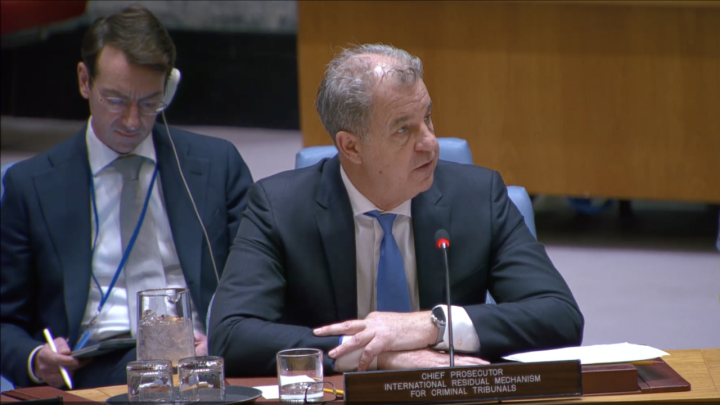
Today, Prosecutor Serge Brammertz of the International Residual Mechanism for Criminal Tribunals (Mechanism) addressed the United Nations Security Council regarding the work of the Office of the Prosecutor (OTP).
In his 27th Progress Report to the Security Council, Prosecutor Brammertz provided updates concerning the OTP’s two strategic priorities: litigation of mandated residual matters; and assistance to national jurisdictions prosecuting international crimes committed in Rwanda and the former Yugoslavia.
With respect to Prosecutor v. Kabuga, the Prosecution has argued that Kabuga could be repatriated to Rwanda, which is the only country willing and able to accept him. On 13 November, the Trial Chamber issued its decision concluding that Kabuga cannot be flown to Rwanda and requesting European States to accept Kabuga into their territories. The Prosecution appealed this decision on 28 November.
Regarding the referred case against Fulgence Kayishema, who was arrested on 24 May 2023 but remains in South African custody, the Prosecution filed seven submissions during the reporting period opposing Kayishema’s efforts to further delay his trial and frustrate the justice process. Prosecutor Brammertz urged South Africa to immediately surrender Kayishema to the Mechanism in accordance with the Arrest Warrant, noting, “Too much time has already passed, and Kayishema’s victims deserve to see justice finally delivered.”
The OTP continued to provide extensive assistance to Member States investigating and prosecuting the crimes committed in Rwanda and the former Yugoslavia. In the last six months, 76 national cases in 13 countries were supported by the OTP. Notably, in June 2025, acting on intelligence provided by the OTP, Rwandan authorities took into custody the fugitive Fulgence Niyibizi, who had been indicted more than a decade ago for crimes committed in Butare. Similarly, an indictment was filed by Montenegrin authorities based on an investigative dossier previously transferred by the OTP.
In his remarks to the Council, Prosecutor Brammertz reflected on the results achieved by the Mechanism since its establishment in 2010, particularly in accounting for ICTR and ICTY fugitives. As he noted, “At that time, the pace of arrests had slowed, and it was unknown when, or even if, fugitives would be arrested and trials would commence.” In contrast, today, “All ICTR and ICTY fugitives have been accounted for. All international trials of fugitives have been concluded. What seemed nearly impossible in 2010 has been fully achieved.”
At the same time, the Mechanism has another vital mandate, to assist domestic efforts to achieve justice. Since the adoption of the Completion Strategies in 2004, Member States have assumed full responsibility to continue the accountability process. The OTP has supported these efforts by responding to more than 4,000 requests for assistance. Prosecutor Brammertz noted that “[a]s international justice was winding down, national justice took its place and continued achieving accountability, as the Council intended.”
Looking forward, Prosecutor Brammertz informed the Council that “more work remains to be done at the domestic level, with important challenges that must be overcome. Many victims and survivors are still waiting for justice, while the families of the missing are still searching for their loved ones. The passage of time only makes the need to address their suffering more urgent.”
Turning to the Security Council’s consideration next year whether to extend the Mechanism’s mandate, Prosecutor Brammertz emphasized that “national investigations and prosecutions will remain at a high level for a number of years to come.” He expressed his view that it will be critical to ensure that the United Nations continues to provide Member States with the assistance they need.
Finally, the Prosecutor stated, “In conclusion, with the Council’s continued support and the dedicated efforts of Mechanism staff, we can now say that the Mechanism accomplished its most important mission.” As he noted, “Finalizing the last trials of the ICTR and ICTY was of immense importance to the victims, affected societies and international community.” He further noted that the future of the accountability process is now at the domestic level, recognizing that “[h]ere too the Council played a decisive role in spurring the adoption of the Completion Strategies and the transfer of responsibilities to Member States. Even as more work remains to be done, the results so far are undeniable, thanks to the Council’s leadership. “