
President Gatti Santana briefs the UN Security Council on progress of Mechanism work
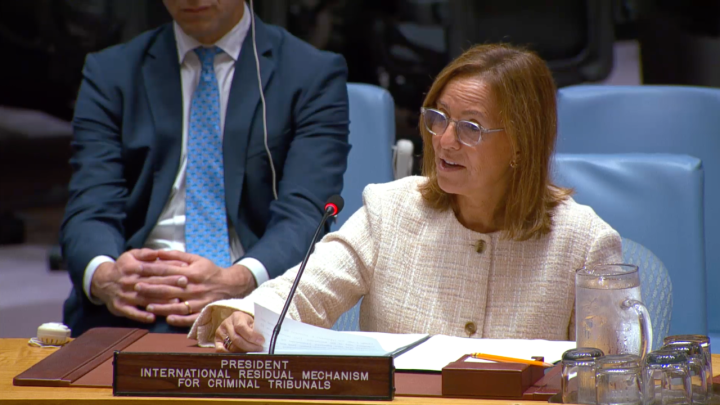
Today, the President of the International Residual Mechanism for Criminal Tribunals (Mechanism), Judge Graciela Gatti Santana, addressed the United Nations Security Council (Council), which is currently reviewing the Mechanism’s work and progress. During her briefing, she presented the Mechanism’s sixth review report and twenty‑eighth progress report to the Council.
At the outset, President Gatti Santana recalled the significant contributions to international justice made by the ad hoc Tribunals and the Mechanism – achievements made possible through decades of committed bilateral and multilateral cooperation and the Council’s enduring support. She emphasised that accountability for international crimes through trials that adhere to the highest standards has become an essential component of reconciliation and durable peace. Noting that only limited, yet still essential, work remains for the Mechanism, the President stressed that the Security Council's forthcoming decisions on the Mechanism’s mandate will have important implications for the United Nations’ continuing responsibilities towards those within its duty of care, as well as for the future of international criminal justice.
President Gatti Santana then elaborated on the ambitious Stategic Plan for the future of the Mechanism and its operations, which the Mechanism’s Principals have developed and shared with the Council. This Plan builds on two reports issued by the United Nations Secretary-General on 1 December 2025 regarding the transferability of certain functions of the Mechanism, as well as the recent evaluation of the Mechanism’s work and methods by the Office of Internal Oversight Services. The Strategic Plan presents concrete proposals, which if adopted by the Council, will result in the completion and transfer of several Mechanism functions and the institution’s substantial downsizing, re-organization and physical consolidation.
The President explained that, in line with the Secretary-General’s recommendations, the Strategic Plan proposes that the prosecutorial assistance to national jurisdictions and the preservation and management of the archives can be transferred to the United Nations Secretariat, and that the function of day-to-day supervision of conditions of imprisonment can be transferred to enforcement States, provided that international standards are maintained. With respect to the latter, the President expressed the Mechanism’s profound thanks to the Member States that have demonstrated their willingess to take over this responsibility, acknowledging their essential role and substantial contribution to international justice. She further noted that the Strategic Plan recommends the termination of certain resource-intensive prosecutorial and judicial functions, including in-court proceedings, that can effectively be carried out by States.
President Gatti Santana indicated that there are, however, a number of limited but key judicial functions –related to transfer and release of prisoners, witness protection, non bis in idem, and the power to refer, monitor, and revoke cases – that remain essential to the conclusion of the justice cycle and should remain at the international level. These functions implicate core principles of legality, equality and due process. These particular functions, she said, cannot feasibly be transferred to States or to the United Nations Secretariat, and their retention at the international level supports the consistent application of the law, legal certainty and fairness.
By way of example, the President highlighted the importance of ensuring the continuous and active ability to adjudicate requests for release submitted by the 38 convicted persons currently serving their sentences under the Mechanism’s supervision. She noted that applications for early release from prisoners who have reached the eligibility threshold, as well as requests for release on humanitarian grounds, constitute an ongoing judicial responsibility that cannot be allowed to lapse. The President further emphasised that retaining this function at the international level, and specifically within the Mechanism, as proposed by the Secretary-General and the Strategic Plan, is the most cost-effective and efficient option and guarantees continuous oversight and consistent application of the law.
President Gatti Santana also underscored that, while durable justice does not conform to clear or finite timelines, the Strategic Plan provides a viable path towards the responsible completion of the justice cycle that recognizes that this final phase cannot be completed by relinquishing the guarantees that give international justice its legitimacy in the first place.
In closing, President Gatti Santana extended her profound gratitude to the dedicated and exemplary staff of the Mechanism, who have, time and again, reaffirmed their commitment to implementing the international community’s will to achieve durable justice notwithstanding continuous professional insecurity.