
President Gatti Santana briefs the UN Security Council on progress of Mechanism work
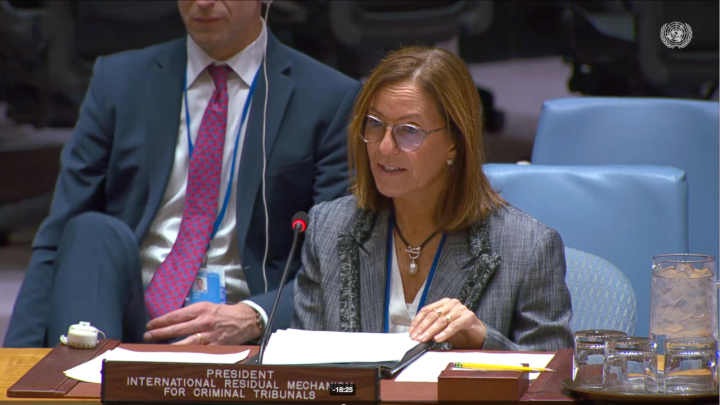
Today, the President of the International Residual Mechanism for Criminal Tribunals (Mechanism), Judge Graciela Gatti Santana, presented the Mechanism’s twenty-seventh progress report to the United Nations Security Council (Council) in New York.
President Gatti Santana commenced her remarks by highlighting that the Mechanism’s mandate continues to carry “real responsibilities to real people”, including the judicial oversight of protective measures granted to approximately 3,200 protected victims and witnesses, supervision of the enforcement of sentences for 40 prisoners, assistance to national prosecutions, and the management of the archives of the Tribunals for Rwanda and the former Yugoslavia.
The President stressed that the Mechanism remains active, with its Judges issuing nearly 80 decisions and orders during the six-month reporting period. Notable judicial activity included a Single Judge’s referral of the last active contempt case before the Mechanism to the United States of America, which is currently under appeal. Separately, in the Fulgence Kayishema case, the Trial Chamber dismissed three of the four grounds raised in a request to revoke the referral of the case to Rwanda, and can now adjudicate the remaining ground, having received submissions from South Africa. In connection with the acquitted and released persons relocated to Niger four years ago, a Single Judge has determined that, after 31 December 2026, the Mechanism will no longer have a legal or judicial obligation to provide financial assistance to these individuals. Finally, in the Félicien Kabuga case, the Trial Chamber has found that he is not fit to travel to Rwanda and has invited European States to reconsider accepting him onto their territories. This decision has also been appealed.
Next, President Gatti Santana referred to the reports prepared by the Secretary-General pursuant to resolution 2740 (2024), which consider options for transferring certain of the Mechanism’s residual functions. She welcomed the Secretary-General’s proposals that the technical functions of archives management and the Prosecution’s assistance to national jurisdictions can be assumed by the United Nations Secretariat. Emphasizing the importance of these functions to closing the impunity gap and maintaining a reliable historical resource for research, education, and countering revisionism and denial, she also observed that they do not need to be embedded in a court. The President also confirmed the Mechanism’s support of the Secretary-General’s recommendation that the day-to-day supervision of conditions of imprisonment can be transferred to States under certain circumstances. She mentioned, however, that two convicted persons remained at the United Nations Detention Unit in The Hague and that, until transferred to enforcement States, they will remain a responsibility of the Mechanism and at a substantial cost to the international community.
The President observed that, by contrast, the Secretary-General has indicated that the power to order the transfer of prisoners, designate enforcement States, and decide on applications for pardon, commutation of sentence, or early release should remain at the international level, to ensure the most fair and uniform treatment of convicted persons.
President Gatti Santana also referred to the Secretary-General’s recommendation that these functions be considered together with other residual judicial functions of the Mechanism that are not specifically covered in his reports. In this context, she urged the Council to carefully consider retaining at the international level additional judicial functions, including judicial oversight of protective measures for witnesses and judicial matters affecting due process rights. She remarked that such activity is not resource intensive and will reduce in the coming years, while remaining key to the Tribunals’ legacy and the credibility of judicial processes. In particular, the President emphasised the important role played by Judges in determining whether to vary protective measures and share confidential information with national prosecutors, a process that involves impartially balancing a witness’s circumstances against the applicant’s interest in the protected information.
In closing, the President underscored that the Mechanism has continued to implement efficiency measures in line with the Council’s direction, including further staff reductions and targeted amendments to the Mechanism’s Rules of Procedure and Evidence. She reiterated that the Mechanism remains committed to a responsible conclusion of the justice cycle, whether its long-term residual responsibilities ultimately remain within the Mechanism or are transferred to other suitable institutions.