
MIP participates in online lecture on the ICTY for Munich students of international law and politics
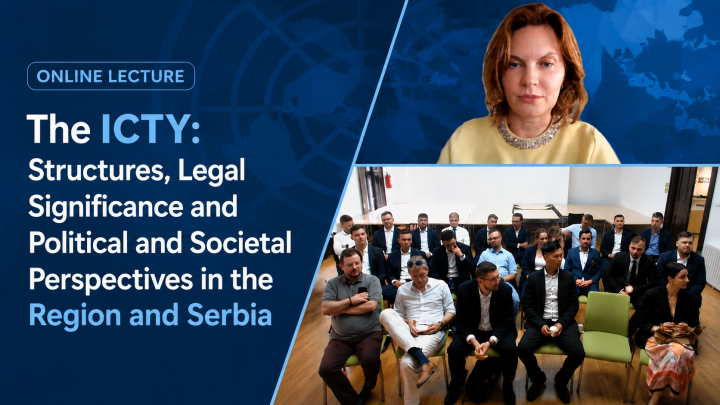
On 22 June, the Mechanism Information Programme for Affected Communities (MIP) participated online in a session titled “The ICTY: Structures, Legal Significance and Political and Societal Perspectives in the Region and Serbia,” organised by Universität der Bundeswehr München as part of its Academic and Research Trip to Belgrade. The event took place at the Goethe‑Institute Belgrade and was attended by 20 master’s students and four faculty members from the graduate specialisation programme International Law and Politics.
Ms. Rada Pejić‑Sremac, Coordinator of the MIP, briefed participants on the continuing work of the International Residual Mechanism for Criminal Tribunals (Mechanism) and on the MIP’s role in preserving the record of crimes committed in the former Yugoslavia during the 1990s conflict. She outlined the challenges the MIP faces in communicating judicially established facts about crimes adjudicated before the International Criminal Tribunal for the former Yugoslavia (ICTY) and the Mechanism. She also described the Programme’s tools - including social media campaigns targeting young people and cooperation with history teachers and law faculties across the former Yugoslavia - used to make those facts accessible to the wider public.
Ms. Sofija Todorović, Director of the NGO Youth Initiative for Human Rights – Belgrade Office, opened the session and spoke about the ICTY’s establishment, work and legacy, its reception in Serbia and the wider region, and the challenges of transitional justice and memory politics.
The event concluded with an extended discussion and a question‑and‑answer session involving students and faculty.
The MIP’s participation in this event forms part of the Programme’s efforts to support projects and events organised by civil society organisations active in the field of transitional justice in the region of the former Yugoslavia.
The aim of the MIP is to improve the knowledge and understanding of citizens and communities in the countries of the former Yugoslavia about the crimes committed during the conflicts of the 1990s, based on the jurisprudence of the ICTY and the Mechanism.
The MIP is funded by the European Union.