Termination of Proceedings in the Case Against Félicien Kabuga
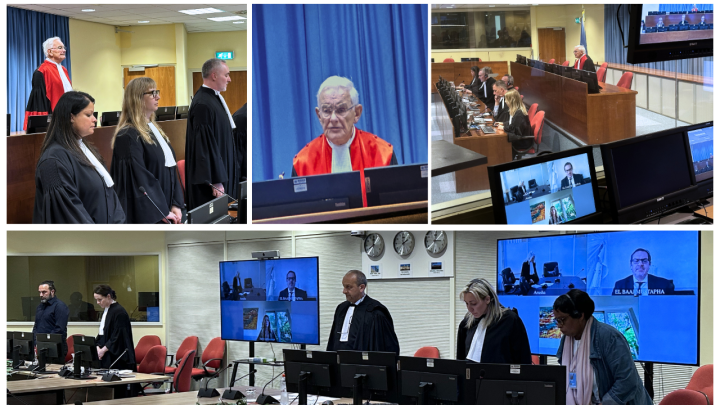
The Trial Chamber, composed of Judge Iain Bonomy, presiding, Judge Mustapha El Baaj, and Judge Margaret M. deGuzman, terminated the proceedings in the case of Prosecutor v. Félicien Kabuga before the International Residual Mechanism for Criminal Tribunals (Mechanism) during a hearing held today, Wednesday, 20 May 2026 in The Hague, the Netherlands. Mr. Kabuga passed away on Saturday, 16 May 2026 while in the prison hospital in The Hague. A written decision formally terminating the case was also issued following the hearing.
Mr. Kabuga was alleged to be the President of the Comité provisoire of the Fonds de défense nationale (National Defence Fund) from April 1994 to July 1994 and President of the Comité d’initiative of Radio Télévision Libre des Milles Collines (RTLM). He was first indicted by the International Criminal Tribunal for Rwanda (ICTR) on 26 November 1997 and, following over two decades as a fugitive, was arrested in the Republic of France on 16 May 2020, pursuant to a warrant of arrest and order for transfer issued by the Mechanism on 29 April 2013. Mr. Kabuga was transferred to The Hague Branch of the Mechanism on 26 October 2020.
Mr. Kabuga stood charged with six counts of genocide, conspiracy to commit genocide, incitement to genocide, and crimes against humanity, including persecution, extermination, and murder, committed during the 1994 genocide against the Tutsi in Rwanda. According to the amended Indictment, filed on 1 March 2021 by the Prosecutor of the Mechanism, Mr. Kabuga allegedly operated the RTLM radio station with others in a manner that furthered hatred and violence and disseminated an anti-Tutsi message with the goal to eliminate the Tutsi ethnic group in Rwanda. He was also alleged to have provided material, logistical, financial, and moral support to the Interahamwe who killed and harmed Tutsi and others perceived “accomplices” or “allies” in Kigali-Ville, Gisenyi, and Kibuye prefectures, including by raising funds to purchase weapons and ammunition.
Mr. Kabuga’s trial commenced on 29 September 2022, in the context of the COVID-19 pandemic, following extensive pre-trial litigation and the assessment of his mental and physical health by a panel of independent medical experts. Between September 2022 and March 2023, the Trial Chamber heard the oral evidence of 24 Prosecution witnesses in court, having adopted tailored modalities and sitting hours to accommodate Mr. Kabuga’s health condition and ensure his effective participation in the trial proceedings. The Trial Chamber also took judicial notice of 45 adjudicated facts and, by March 2023, had ruled on the admissibility of 505 exhibits, including the written evidence of 94 Prosecution witnesses.
The evidentiary hearings were thereafter suspended due to the rapid and steady decline of Mr. Kabuga’s health. On 6 June 2023, having received further reports and compelling evidence from a panel of independent medical experts, as well as medical reports from the Reporting Medical Officer of the United Nations Detention Unit (UNDU), the majority of the Trial Chamber rendered a decision finding Mr. Kabuga unfit to stand trial. In that decision, the majority of the Judges nonetheless decided to proceed with an alternative finding procedure, which, in its view, was in line with generally accepted human rights norms and the United Nations Convention on the Rights of Persons with Disabilities.
In a decision issued on 7 August 2023, the Appeals Chamber, while affirming the determination that Mr. Kabuga was unfit to stand trial, concluded that the Mechanism’s legal framework did not allow for an alternative finding procedure and remanded the matter back to the Trial Chamber. On 8 September 2023, the Trial Chamber, pursuant to the Appeals Chamber’s instruction, imposed an indefinite stay of proceedings and ordered that Mr. Kabuga remain in detention at the UNDU in The Hague under a medical monitoring regime pending his provisional release.
The Trial Chamber subsequently issued numerous judicial decisions and orders in relation to Mr. Kabuga’s requests addressed to certain European States to facilitate his expeditious release and further explored the possibility to transfer him to Rwanda, his country of nationality. Despite these efforts, European States remained reluctant to accept him onto their territory. In view of Mr. Kabuga’s serious and deteriorating medical condition, supported by medical experts, the Trial Chamber ultimately determined that he was also unfit to be flown inter-continentally, which precluded his release in Rwanda. This determination was recently affirmed on appeal. At the time of his death, Mr. Kabuga was still in custody at the UNDU awaiting a solution in relation to his provisional release.
During the hearing held today, the Trial Chamber expressed its regret that the trial could not have reached its conclusion in some form on the merits. Judge Bonomy further stated that the end of the case against Mr. Kabuga highlights the need for increased international cooperation, as well as a need for international courts to continue to examine how to appropriately address problems that arise following a determination that an accused is permanently unfit to stand trial. Prior to adjourning the proceedings for the final time, Judge Bonomy recognized the significance of the proceedings against Mr. Kabuga as the closure of the last case involving crimes committed in Rwanda or the former Yugoslavia before the Mechanism.
Background
On 22 December 2010, the United Nations Security Council adopted resolution 1966 (2010), establishing the Mechanism to continue the jurisdiction, rights and obligations, and to carry out the essential functions of the ICTR and the International Tribunal for the former Yugoslavia (ICTY).
The Mechanism commenced operations on 1 July 2012 in Arusha, United Republic of Tanzania, and on 1 July 2013 in The Hague, The Netherlands. During its initial years, the Mechanism operated alongside the ICTR and ICTY. Following the closure of the ICTR on 31 December 2015 and the ICTY on 31 December 2017, the Mechanism has continued its work as a stand-alone institution.
****
For more information on the case, please visit:
https://www.irmct.org/en/cases/mict-13-38
****