
Seventh cycle of the Inter‑University Video Lecture Programme concludes with lecture by Registrar Abubacarr M. Tambadou
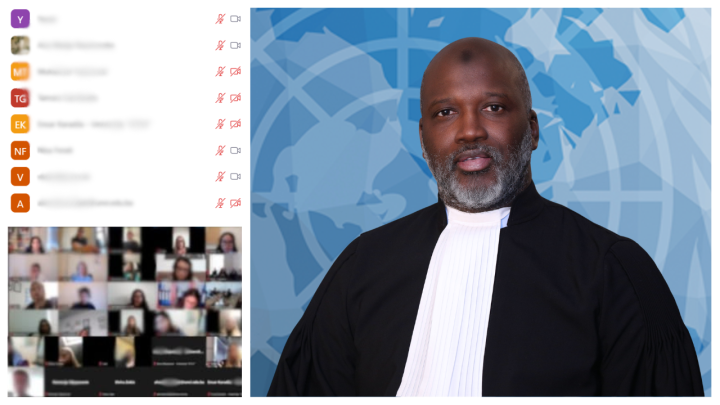
The Registrar of the International Residual Mechanism for Criminal Tribunals (Mechanism), Mr. Abubacarr M. Tambadou, delivered today a lecture on the role and functions of the Mechanism, marking the successful conclusion of the seventh cycle of the Inter‑University Video Lecture Programme (Programme), titled International Law and Facts Established before the International Criminal Tribunal for the former Yugoslavia (ICTY).
The lecture was attended by law students from 14 law faculties, one political science faculty, and one faculty of philosophy across the region of the former Yugoslavia.
During his lecture, Registrar Tambadou provided a comprehensive historical overview of the Mechanism’s establishment and work, explaining its specific roles and functions. He outlined the challenges faced by the Mechanism in assuming responsibilities previously carried out by the International Criminal Tribunal for Rwanda (ICTR) and the ICTY. Drawing comparisons, he discussed the similarities and key differences between the mandates of the Mechanism and its two predecessor tribunals. The session concluded with an engaging Q&A, where the Registrar highlighted the crucial role of young people in upholding the principles of international justice and ensuring that its legacy remains relevant for future generations.
This final lecture was the thirteenth session in the seventh cycle of the Programme, which began in November 2025 with a lecture by the Mechanism’s President, Judge Graciela Gatti Santana, on the establishment and jurisdiction of the ICTY. Over the course of the Programme, legal experts - including Principals, Judges, and Mechanism staff - delivered lectures on the ICTY’s legacy and jurisprudence. Among them was Judge Alphons Orie, a current Mechanism Judge and former ICTY Judge, who discussed the contributions of the ICTY and Mechanism to the system of international accountability.
Additional contributors from the Mechanism to this lecture cycle included:
- Gregory Shankman, Legal Officer in the Chambers Legal Support Section, who spoke about the contributions of ICTR, ICTY and the Mechanism to the development of international criminal and humanitarian law;
- Laurel Baig, Senior Appeals Counsel in the Office of the Prosecutor, who spoke about the work and mandate of the Prosecutor’s Office;
- Evangelia Sarikaki, Legal Officer in the Office of the President, who examined crime of genocide in the jurisprudence of the ad hoc Tribunals;
- Representatives from the Witness Support and Protection Unit (WISP), who provided insights into the support and assistance offered to victims and witnesses appearing before the ICTY and Mechanism;
- Emiliya Viktorova, Senior Legal Officer in the Chambers Legal Support Section, who discussed the destruction of cultural heritage; and
- Diana Tseng, Legal Officer in the Mechanism Chambers, who addressed legal principles of joint criminal enterprise in ICTY, ICTR, and Mechanism jurisprudence.
Lectures in the seventh cycle were also delivered by:
- Marie O'Leary, President of the Executive Committee of the Association of Defence Counsel to the International Criminal Tribunals, who discussed safeguarding the rights of the accused and the right to self‑representation;
- Gregory Townsend, senior lecturer in international law and former ICTY staff member, who spoke on prosecuting wartime sexual violence at the ICTY;
- Enis Omerović, Dean of the Faculty of Law at the University of Zenica, Bosnia and Herzegovina, who spoke about the prosecution and legal framework of crimes against humanity; and
- Ivan Jovanović, a legal expert at the United Nations Development Programme, who discussed the role of the ICTY and Mechanism in processing war crimes cases before national judiciaries in the former Yugoslavia.
In collaboration with participating universities, the Mechanism Information Programme (MIP) has created a regional network of law faculties - the first of its kind - where law students from different Balkan countries can learn about and discuss the ICTY’s work and legacy. This lecture series not only enhances students’ knowledge of international criminal and humanitarian law but also serves as a platform for dialogue among law students from the countries of the former Yugoslavia.
The network includes the faculties of law of the following universities: the University “Union” in Belgrade, the University of Donja Gorica, the University of Niš, Haxhi Zeka University of Peja, the University of Podgorica, the University of Pristina, the University of Rijeka, the University of Sarajevo, Ss. Cyril and Methodius University of Skopje, the University of Split, the University of Tuzla, the University of Vitez, the University of Zagreb, and the University of Zenica, as well as the Faculty of Humanities – Department of History of the Juraj Dobrila University of Pula and the Faculty of Political Sciences of the University of Sarajevo.
The Programme is part of the broader Mechanism Information Programme for Affected Communities (MIP), launched in January 2019, which aims to raise awareness and understanding of the 1990s conflicts in the former Yugoslavia, based on ICTY and Mechanism cases. The MIP is funded by the European Union.