
MIP participates in Transitional Justice School for young legal professionals
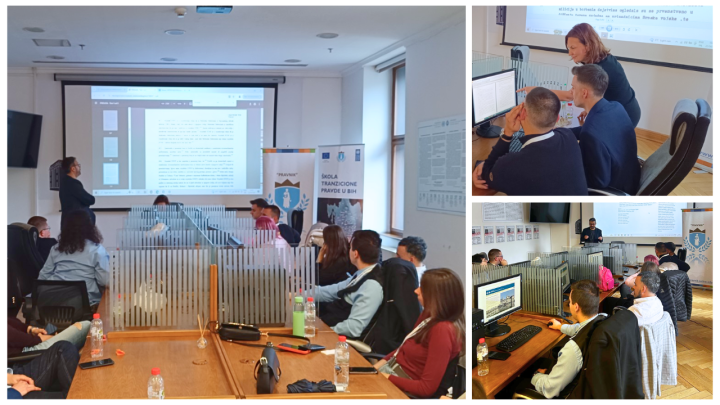
On 21 and 22 April 2026, the Mechanism Information Programme for Affected Communities (MIP) participated in the Sixth School of Transitional Justice in Sarajevo, Bosnia and Herzegovina. The event was organised by partner organisation Pravnik and supported by the European Union and United Nations Development Programme. The School brought together 24 students from law and social science universities across Bosnia and Herzegovina. Over the course of the week, participants attended lectures addressing various aspects of transitional justice related to the conflicts in the former Yugoslavia. Students engaged with academics and civil society representatives and gained practical experience through peace negotiation simulations. Parts of the programme were held at the Sarajevo Information Center on the International Criminal Tribunal for the former Yugoslavia (ICTY).
MIP Coordinator Rada Pejić‑Sremac and MIP Researcher Nemanja Stjepanović presented on the legacy of the ICTY and its successor, the International Residual Mechanism for Criminal Tribunals (IRMCT). Their presentations highlighted the tribunals’ key achievements for transitional justice in the former Yugoslavia and illustrated these points with judicially established facts and archival materials.
On the second day, they led a practical workshop on using the Mechanism’s Unified Court Records to research cases and sources. The workshop equipped students with hands on skills to locate and interpret judicial evidence from the 1990s conflicts. Participants worked in small groups on assigned research topics and presented their findings.
Participation in the School forms part of the MIP's efforts to support projects and events implemented by civil society organizations active in the field of transitional justice in the former Yugoslavia.
The sessions underlined the importance of outreach in transitional justice. By making court records and judicially established facts accessible to young legal professionals and students, MIP helps strengthen the rule of law, improve public debate and support reconciliation.
The aim of the MIP is to improve the knowledge and understanding of citizens and communities in the countries of the former Yugoslavia about the crimes committed during the conflicts of the 1990s, based on the jurisprudence of the ICTY and the Mechanism.
The MIP is funded by the European Union.