
MIP participates in Srebrenica Youth School 2026
On 8 July 2026, the Mechanism Information Programme for Affected Communities (MIP) took part in the Srebrenica Youth School 2026, organized by the Post-Conflict Research Center (PCRC), by delivering an online lecture and workshop from The Hague. The week long programme brought together young participants from multiple countries to explore transitional justice, remembrance, and reconciliation through lectures, workshops, discussions, and field visits to Sarajevo, Tuzla, and Srebrenica.
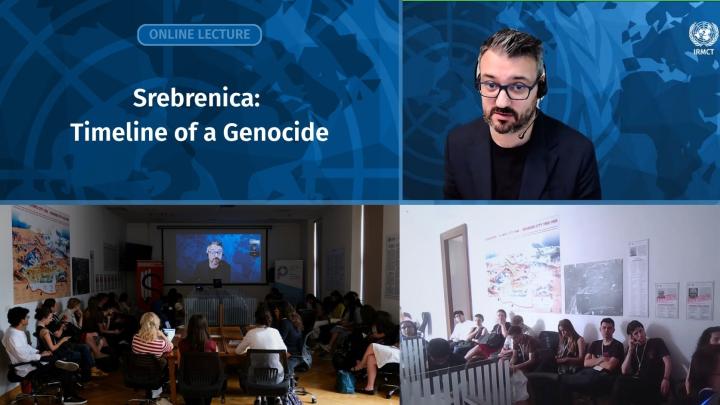
MIP researcher Mr. Nemanja Stjepanović delivered an online lecture and workshop titled Srebrenica: Timeline of a Genocide to participants gathered at the Sarajevo Information Centre on the International Criminal Tribunal for the former Yugoslavia (ICTY). The session presented the chronology of events before, during, and after the July 1995 genocide, drawing on findings of the ICTY and the International Residual Mechanism for Criminal Tribunals (the Mechanism).
The session introduced participants to judicially established facts about the Srebrenica genocide and demonstrated how evidence presented to the ICTY and the Mechanism has helped establish an authoritative historical record. It also highlighted the importance of the Mechanism’s archives as a resource for education, research, memorialization, and for countering genocide denial and historical revisionism.
Held from 6 to 12 July 2026, the Srebrenica Youth School brought together experts from international organizations, academia, and civil society to engage young people in discussions on accountability, memory, and peacebuilding. The programme included educational visits to the International Commission on Missing Persons (ICMP) in Tuzla and the Srebrenica Memorial Center, where participants took part in activities marking the 31st anniversary of the Srebrenica genocide.
Participation in the Srebrenica Youth School forms part of the MIP's efforts to support projects and events implemented by civil society organizations active in the field of transitional justice in the region of the former Yugoslavia.
The aim of the MIP is to improve the knowledge and understanding of citizens and communities in the countries of the former Yugoslavia about the crimes committed during the conflicts of the 1990s, based on the jurisprudence of the ICTY and the Mechanism.
The MIP is funded by the European Union.
On 8 July 2026, the Mechanism Information Programme for Affected Communities (MIP) took part in the Srebrenica Youth School 2026, organized by the Post-Conflict Research Center (PCRC), by delivering an online lecture and workshop from The Hague. The week long programme brought together young participants from multiple countries to explore transitional justice, remembrance, and reconciliation through lectures, workshops, discussions, and field visits to Sarajevo, Tuzla, and Srebrenica.
MIP researcher Mr. Nemanja Stjepanović delivered an online lecture and workshop titled Srebrenica: Timeline of a Genocide to participants gathered at the Sarajevo Information Centre on the International Criminal Tribunal for the former Yugoslavia (ICTY). The session presented the chronology of events before, during, and after the July 1995 genocide, drawing on findings of the ICTY and the International Residual Mechanism for Criminal Tribunals (the Mechanism).
The session introduced participants to judicially established facts about the Srebrenica genocide and demonstrated how evidence presented to the ICTY and the Mechanism has helped establish an authoritative historical record. It also highlighted the importance of the Mechanism’s archives as a resource for education, research, memorialization, and for countering genocide denial and historical revisionism.
Held from 6 to 12 July 2026, the Srebrenica Youth School brought together experts from international organizations, academia, and civil society to engage young people in discussions on accountability, memory, and peacebuilding. The programme included educational visits to the International Commission on Missing Persons (ICMP) in Tuzla and the Srebrenica Memorial Center, where participants took part in activities marking the 31st anniversary of the Srebrenica genocide.
Participation in the Srebrenica Youth School forms part of the MIP's efforts to support projects and events implemented by civil society organizations active in the field of transitional justice in the region of the former Yugoslavia.
The aim of the MIP is to improve the knowledge and understanding of citizens and communities in the countries of the former Yugoslavia about the crimes committed during the conflicts of the 1990s, based on the jurisprudence of the ICTY and the Mechanism.
The MIP is funded by the European Union.